Warm Waters, Shifting Worlds: How a Changing Pacific Is Redrawing the Map of Marine Life
For generations, the rhythm of life along the North American Pacific coast has been set by the ocean itself — its cold upwellings, its seasonal currents, its ancient thermal boundaries. But that rhythm is changing. Surface temperatures across wide stretches of the North Pacific have climbed measurably over the past four decades, and the effects are cascading through marine food webs in ways scientists are only beginning to fully document.
The Pacific, stretching from the Bering Sea to the equatorial tropics, is not warming uniformly. Yet the trend lines are unmistakable. According to data compiled by the National Oceanic and Atmospheric Administration (NOAA), average sea surface temperatures along the U.S. West Coast have increased by roughly 1 to 2 degrees Celsius over the past century, with the pace of change accelerating since the 1980s. While those numbers may seem modest, marine biologists emphasize that ocean ecosystems are extraordinarily sensitive to even fractional temperature shifts.
"The ocean doesn't need to warm by ten degrees to fundamentally reorganize," said one marine ecologist affiliated with a Pacific-focused research institution. "A degree or two at the right thermal boundary is enough to move species hundreds of miles."
Thermal Boundaries and the Biology of Belonging
One of the central concepts driving current research is the idea of thermal envelopes — the specific temperature ranges within which a given species can survive, reproduce, and compete effectively. Every organism in the Pacific, from microscopic phytoplankton to humpback whales, operates within one of these envelopes. As ocean temperatures rise, those envelopes shift poleward, and the species within them follow.
This poleward migration is already well-documented in several key groups. Pacific sardines, historically associated with waters off California and Baja California, have extended their range northward into Oregon and Washington in recent decades. Certain shark species more commonly observed in Mexican waters are appearing with greater frequency off the coast of central California. Meanwhile, cold-water specialists — organisms that evolved in the frigid upwelling zones characteristic of the California Current system — face shrinking habitat as their thermal refuge contracts.
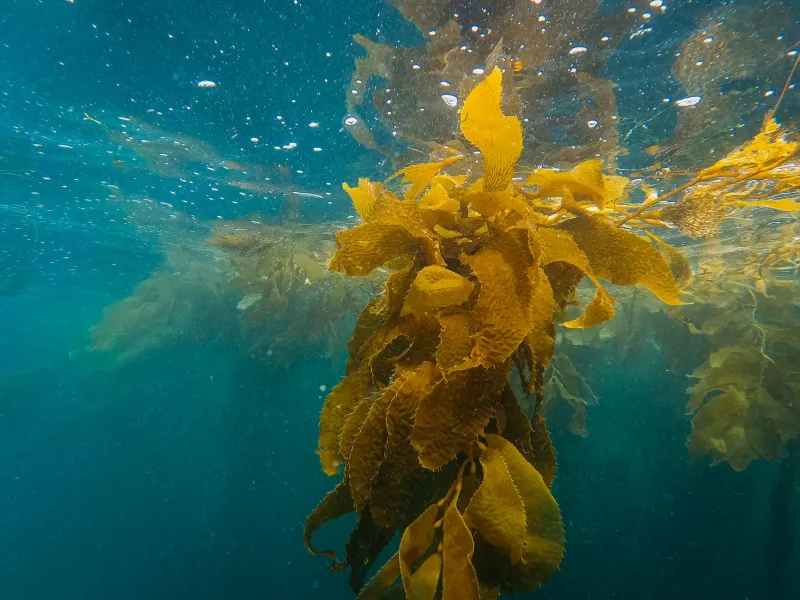
Perhaps nowhere is this disruption more visible than in the region's kelp forests. Giant kelp, which forms the structural backbone of one of the Pacific's most biodiverse ecosystems, is highly sensitive to water temperature. Sustained warming, combined with a surge in sea urchin populations following the collapse of their natural predators, has devastated kelp canopy coverage along significant stretches of the Northern California coast. Some surveys have recorded losses exceeding 95 percent in specific areas — a transformation that effectively dismantles habitat for hundreds of dependent species simultaneously.
Alaska's Shifting Salmon Economy
Further north, the stakes are equally high, though the dynamics differ. Alaska's commercial fisheries represent one of the most economically significant in the world, with salmon at the center of both the industry and Indigenous cultural life. Researchers monitoring the Gulf of Alaska and surrounding waters have noted that warming temperatures are altering the timing of salmon runs, shifting prey availability, and affecting juvenile survival rates in ways that complicate both fisheries management and the livelihoods of communities that depend on predictable harvests.
The 2019 collapse of Pacific cod stocks in the Gulf of Alaska — attributed in significant part to elevated water temperatures during a preceding marine heat wave — offered a stark preview of what sustained warming might mean at scale. Cod larvae require cold, nutrient-dense water to survive their earliest developmental stages. When the thermal environment shifts outside those parameters, recruitment fails, and populations can decline precipitously within just a few years.
For fishing communities from Kodiak to Sitka, these are not abstract ecological concerns. They translate directly into permit values, processing plant revenues, and the viability of small-boat fishing operations that have anchored local economies for over a century.
The Blob and Its Legacy
No single event has done more to focus scientific attention on Pacific thermal dynamics than the marine heat wave researchers informally dubbed "the Blob" — a vast mass of anomalously warm water that settled over the northeastern Pacific between roughly 2013 and 2016. At its peak, the Blob elevated surface temperatures by as much as 4 degrees Celsius above average across an enormous swath of ocean, triggering one of the most dramatic ecological disruptions on record in the region.
The consequences were sweeping. Harmful algal blooms proliferated, producing domoic acid that contaminated shellfish and temporarily shut down Dungeness crab fisheries along the entire West Coast. Tens of thousands of seabirds washed ashore, starved because the warm water had displaced the forage fish they relied upon. Unusual marine mammal strandings spiked from California to British Columbia.
While the Blob eventually dissipated, researchers caution that its conditions are likely to become more frequent as baseline ocean temperatures continue to rise. What was once an anomaly may become a recurring feature of the Pacific's thermal landscape — with the ecological disruptions it produces growing correspondingly harder to absorb.
Rethinking Fisheries Management for a Warmer Ocean
The scientific community is increasingly focused on translating these findings into practical guidance for fisheries managers and coastal policymakers. Traditional management frameworks were built around the assumption of relatively stable environmental baselines — fixed thermal zones, predictable migration corridors, consistent recruitment patterns. Those assumptions are no longer reliable.
Some researchers advocate for what they term climate-adaptive management: frameworks that incorporate real-time oceanographic data, allow for more flexible catch limits, and anticipate species range shifts rather than reacting to them after populations have already relocated. Several Pacific fisheries councils have begun integrating ecosystem indicators into their assessment models, though the pace of institutional adaptation has not always kept up with the pace of ecological change.
There is also growing recognition that Indigenous fishing communities — whose traditional ecological knowledge often spans far longer time horizons than conventional scientific monitoring — have an indispensable role to play in tracking and interpreting these shifts. Tribal nations along the Pacific Northwest coast have documented changes in salmon behavior and timing that align with, and in some cases preceded, findings from formal research programs.
A Coast at a Crossroads
The Pacific coastline of North America, stretching nearly 8,000 miles from the Alaskan Arctic to the Mexican border, encompasses an extraordinary diversity of marine environments, cultures, and economies. What unites them, increasingly, is exposure to a common force: an ocean warming faster than at any point in the historical record.
The research emerging from institutions across this coastline paints a picture not of sudden catastrophe but of gradual, relentless reorganization — ecosystems finding new equilibria, species pressing against the limits of their thermal tolerances, communities recalibrating centuries-old relationships with the sea. Whether those communities, and the regulatory frameworks meant to support them, can adapt quickly enough remains the defining environmental question facing the Pacific coast in the decades ahead.
For the scientists working to understand these shifts, the urgency is unambiguous. The thermal fingerprint of climate change is already written across the Pacific. The task now is learning to read it — and to act on what it says.